
Worms and Parasite Issues with the Boxer Dog
Overview
Many dog owners think of worms as being an issue that only affects puppies in dirty conditions or assume that this is a concern only with newborn puppies and therefore something that a breeder takes care of before the pup goes to his new home.
However, every puppy owner should understand about this serious issue. This sort of parasitic invasion of a dog's body can happen to any dog of any age.
Let's discuss the most common worms that can affect a Boxer dog.
We will talk about how a Boxer may get worms, what you can do to prevent this or treat this and how to know if your Boxer dog has worms.
Tapeworms
What are these?
Tapeworms are flat worms with segments across the body. The head usually has suckers or muscular grooves that enable the tapeworm to attach itself to the animal’s intestine. An adult tapeworm living inside a Boxer dog can be as large as 20 inches ( 50 cm ) long. The tapeworm stays alive by sucking nutrients from the dog through it's skin.
How does a Boxer dog get tapeworms?
A dog can get tapeworms by swallowing a flea. Fleas can contain tapeworm eggs. In rare cases, a Boxer that gains access to a rodent or lizard may get tapeworms from these animals also.
How do I know if my Dog has tapeworms?
You will know that your Boxer dog has tapeworms when you see dried segments of the tapeworm around the dog's anus. These will be about as small as a grain of rice. Because this parasite causes irritation, your Boxer dog may shuffle his rear across the ground. Full worms may actually be present in the dog's bowel movement; these worms can actually be seen moving.
How do I Prevent This?
A puppy should have a feces analysis performed by a veterinarian at the age of 20 days. This is done because a Boxer puppy
can be born with tapeworms. If found, the dog should be de-wormed, which is done with medication given by a veterinarian. After that, vaccinations, which begin at the age of 6 weeks, will help prevent this.
What is the Treatment?
If you suspect that your dog has tapeworms, you veterinarian will most likely want to examine a stool sample. Once confirmed, this is very treatable with medication.
Of the possible medications, one that is generally well tolerated is praziquante, which can be given either orally or via injection. This cause tapeworms to dissolve within a dog's intestines.
Hookworms
What are these?
Hookworms are a nasty little worm. This parasite hooks onto a dog's intestine with its sharp teeth and then it pokes a hole in a blood vessel. It will then begin to suck blood from the dog. If a Boxer dog was infested with 300 hookworms, the dog would lose 5 to 10% of his blood supply each day. For this reason, hookworms can be fatal if not treated.
How does a Boxer dog get hookworms?
There are 3 ways that a dog may get hookworms. A puppy may be born with them, a puppy may get them when drinking mom's milk or a Boxer dog may swallow a hookworm larva. These microscopic larva can be found on anything from blades of grass to infected dog food dishes.
How do I know if my Boxer dog has hookworms?
Once infected, the symptoms will be clear:
- The dog will lose his or her appetite, eating much less food or not at all
- Pale colored mucous membranes may appear in the dog's mouth
- Weakness, emaciation and slowed growth due to lack of appetite
- Vomiting
- Diarrhea - often very black or bloody
Transference to humans:
Hookworms can pass to humans, often through the skin. This can happen if, for example, a person steps barefoot onto hookwarm larvae.
These nasty parasites will burrow into the skin, which causes a disease called cutaneous larva migrans (meaning 'creeping eruption' due to its telltale red lines that spread out. This condition is extremely itchy. Surprisingly, most infestations go away on their own in about two weeks once the larvae die. However, every now and then the larvae can actually find their way to deeper areas or the intestines.
How do I prevent this?
Preventing hookworms is done via several methods. Good hygiene is very important. The dog's feces should not be left in the yard outside. Having human family members wash their hands often is helpful as well as keeping your Boxer dog well groomed and clean. Because hookworms can travel from one dog, to an environment and then on to another dog, it is best to keep away from unclean dog parks.
In addition, if you ever feed your dog homemade food, be sure that the meat is cooked well. When cleaning your home, using bleach on hard surface floors can kill hookworm larvae. The most important prevention is to have your Boxer receive regular checkups and bring your dog to the veterinarian at the first signs of any symptoms.
What is the treatment for a Boxer dog with Hookworms?
Thankfully, despite the havoc that hookworms can play inside a dog's body, mediation can quickly get rids of these worms. Not all de-wormer meds kill hookworms and some just kill the adults but not the larvae. Ivermectin is one that is effective.
Roundworms
What are these?
Roundworms are one of the most common parasites found in dogs. They are rather big, 4 inches (10.1 cm) long. They are usually white in color and resemble a strand of cooked spaghetti. These worms can live inside a Boxer dog's intestine and live off of partial digested food.
How does a Boxer dog get Roundworms?
A puppy may be born with Roundworms if the dam is infected. The puppy may also become infected from its mother's milk.
Even if the dam has tested negative for Roundworms, she may still be infected if the larvae have not fully developed.
A dog may also pick up this parasite by eating soil that contains eggs or by eating or chewing on small rodents.
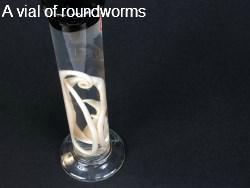
How do I know if my Boxer dog has Roundworms?
You most likely will not know if your Boxer has Roundworms; therefore regular de-worming is very important. Follow the schedule that your dog's veterinarian gives to you.
If not checked and the Boxer dog becomes severely infected with Roundworms:
- The dog may vomit up the worms. You will know that it is a Roundworm because its body will not be segmented as a Tapeworm is.
- The dog may have a swollen stomach
- The dog may show signs of pneumonia as the worms migrate through the dog's body into the lungs and other areas
How do I prevent my Boxer dog from getting Roundworms?
Keeping regular vet checkups and not allowing your dog to chew at outside elements such as soil or rodents will help to keep this at bay.
What is the Treatment?
Medication will work to get rid of these worms. It will cause the worms to let go of the dog's body and pass out through bowel movements. A dog may need more than one round of treatments. Prognosis is good, if this is caught in enough time before too much damage to the dog's body is done.
Heartworms
What are these?
Heartworms are about the same size as the roundworm and tapeworm. An severe case of heartworm disease can be fatal. This worm lives inside of a dog's right ventricle of the heart and nearby blood vessels.
How does a Boxer dog get Heartworms?
It is hard to believe that something as small as a mosquitoes can be so dangerous to a dog! A dog may catch Heartworms when an infected mosquito bites them. Heartworm larvae will enter into the Boxer dog and grow.
Within about 3 months, they will complete their travel to their destination: your Boxer's heart. Growing up to 14 inches (35.5 cm) these worms can overtake a Boxer dog's body. After 6 months, they are reproducing at alarming speed.
How do I know if my Boxer dog has Heart worms?
You usually will not know that a dog has Heartworms until it is too late. Late stages of this canine disease are:
- Weakness
- Weight Loss
- Coughing
Prevention?
Treatment is so simple and easy, yet so many dogs fall victim to Heartworms! There are numerous prevention medications, most over the counter. Never think that your dog does not need this.
What is the treatment?
Once a dog is badly infected, treatment can be very tricky. Arsenic-based drugs are used to kill adult Heartworms and the dog must be very carefully watched by the veterinarian.
Usually a dog will need to have in-patient care for at least several days. As the adult Heartworms are rid from the dog's body, they may block blood vessels to the dog's lungs, causing a pulmonary embolism, which can be fatal.
To help reduce the chance of this happening, the dog must be kept very calm and quiet for 4 weeks following treatment. In the most severe cases, surgery is performed to remove the worms. Both of these treatments are not always successful. In some cases, a dog needs to be euthanized.